

At Arna-Jharna: The Desert Museum of Rajasthan, we see their journey as one that mirrors the desert itself: vast, adaptive, and full of memory.
A Living Legacy
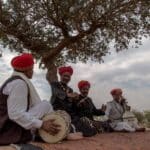
The Manganiyars belong to a hereditary lineage of musicians who traditionally performed for Rajput patrons. Over generations, their role evolved into that of custodians of oral history, preserving genealogies, myths, and devotional poetry through song.
Their repertoire stretches across generations of knowledge — from lullabies and wedding songs to ballads of kings and heroes. Each performance is a living archive, linking past and present through melody and rhythm.
The Desert’s Soundscape
Their instruments — the kamaicha, dholak, and khartal — produce sounds that seem to belong to the desert itself. The kamaicha, made from mango wood and played with a horsehair bow, has a deep, resonant tone that captures the essence of sand, wind, and silence.
When several Manganiyars perform together, their harmonies echo the collective life of the desert — layered, interwoven, and timeless. Their music doesn’t just entertain; it speaks of belonging, faith, and endurance.
From Courtyards to the World Stage
In the last few decades, Manganiyar musicians have found audiences far beyond Rajasthan. From collaborations with world music artists to performances in international festivals, their art has travelled across continents — sometimes transforming in the process, yet always retaining its soul.
This movement has opened new opportunities, but it has also brought challenges — balancing authenticity with adaptation, and sustaining younger generations’ interest in traditional training. At Arna-Jharna, we regularly host folk music evenings that create spaces for these musicians to share their art in its original form — intimate, spontaneous, and deeply rooted in community life.
The Next Generation
One of the most heartening sights is the rise of young Manganiyar musicians. Children who once learned by simply sitting beside elders now perform confidently on stage, blending heritage with curiosity. Supporting these young artists is key to keeping the tradition alive — not as nostalgia, but as a living, breathing practice.
Keeping the Song Alive
Every Manganiyar song carries a world within it — a story of the land, its people, and their spirit. When we listen, we hear not only the music but the desert itself — singing through its people.
Through programs and performances at Arna-Jharna, we hope to ensure that these songs continue to travel, inspire, and connect — across dunes, generations, and geographies.
Plan a Folk Music Experience →